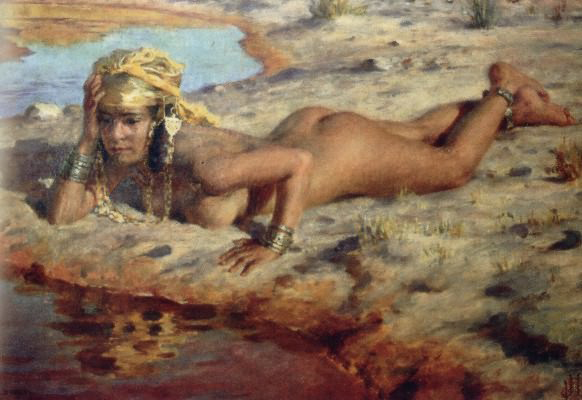
The German artist Ferdinand Max Bredt (1868-1921) painted themes related to women from Muslim countries.
O germânico Ferdinand Max Bredt (1868-1921) pintou temas relacionados com as mulheres dos países Muçulmanos.
Ferdinand Max Bredt (1868-1921)-‘reclining Odalisque’
Ferdinand Max Bredt (1868-1921)-‘Turkish women’-oil on canvas Private collection
Ferdinand Max Bredt (1868-1921)-‘leisure of the Odalisques’-cardboard Private collection
Ferdinand Max Bredt (1868-1921)-‘the queen of the harem’
Ferdinand Max Bredt (1868-1921)-‘in a courtyard, Tunis’ Private collection
Showing posts with label Muslim. Show all posts
2.7.14
10.12.12
Muslim women by Alphonse-Étienne Dinet or Nasreddine Dinet
The Parisian painter Alphonse Etienne Dinet became Nasreddine Dinet (1861-1929) after his conversion to Islam.
O pintor parisiense Alphonse-Étienne Dinet tornou-se Nasreddine Dinet (1861-1929) depois da sua conversão ao Islão.
Alphonse-Étienne Dinet ou Nasreddine Dinet (1861-1929)-'by the wadi'-oil on canvas
Alphonse-Étienne Dinet ou Nasreddine Dinet (1861-1929)-'Arab women and children'-oil on canvas
Alphonse-Étienne Dinet ou Nasreddine Dinet (1861-1929)-'Muslim leaving a village Mosque'-oil on canvas Tokio-Occidental Art Museum
Alphonse-Étienne Dinet ou Nasreddine Dinet (1861-1929)-'Raoucha'-oil on canvas-1901 Alger-Musée des Beaux-Arts
Alphonse-Étienne Dinet ou Nasreddine Dinet (1861-1929)-'bather by moonlight'-oil on canvas
Alphonse-Étienne Dinet ou Nasreddine Dinet (1861-1929)-'ouled nail'-oil on canvas Paris-Musée d'Orsay
19.2.12
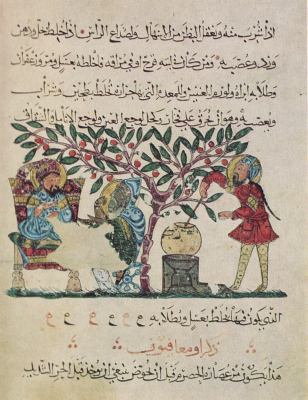
Alchemy in Muslim manuscripts
Due to the influence of peoples integrated into the Islamic Empire, especially of Egyptian origin, there was an extensive development of alchemy among a large number of medical professionals and others.
Por influência dos povos integrados no Império Islâmico, sobretudo de origem Egípcia, houve largo desenvolvimento da alquimia entre grande número de profissionais médicos e outros.
Anonymous-'chemical and pharmaceutical process (1)'-miniature Washington-Smithsonian Institution (Sackler and Freer Gallery)
Anonymous-'chemical process'-miniature miniature Boston-Museum of Fine Arts
Anonymous-'chemical and pharmaceutical process (2)'-miniature Washington-Smithsonian Institution (Sackler and Freer Gallery)
Anonymous-'Miryam and the alchemists'-miniature London-British Library [Persian Ms Nizami's khamsa (five poems),Shiraz (1435-1436)
Anonymous-'symbols inspired by Egyptian hierogliphs'-miniature London-British Library (Ms Add. 25724 / Abu l-Quasim al-Iraqi; Kitab-al-Aqalim)
22.12.10
Muslim Bazaar (Bazar islâmico)
The bazaar is a real shopping centre where you can by all kinds of manufactured articles, especially home-made. The Islamic world displays high-quality handicrafts: carpets, metal artifacts, among others.
O bazar é um verdadeiro centro comercial onde se vende toda a espécie de artigos manufacturados, sobretudo a nível familiar. O mundo Islâmico apresenta artesanato de grande qualidade: tapetes, artigos metálicos e outros.
Frederick Goodall (1822-1904)-'bazaar in Cairo'-oil on canvas-1891 Private collection
Frederick Goodall (1822-1904)-'the grand bazaar'-oil on paper laid down on canvas-1859 Private collection
Edwin Lord Weeks (1849-1903)-'Moorish bazaar'-watercolour-1873 Private collection
John Frederick Lewis (1805-1876)-'the bezestein bazaar of El Khan Khali. Cairo'
Charles Cattermole (1832-1900)-'scene in a Cairo bazaar'-watercolour-1856 London-Victoria and Albert Museum
O bazar é um verdadeiro centro comercial onde se vende toda a espécie de artigos manufacturados, sobretudo a nível familiar. O mundo Islâmico apresenta artesanato de grande qualidade: tapetes, artigos metálicos e outros.
Frederick Goodall (1822-1904)-'bazaar in Cairo'-oil on canvas-1891 Private collection
Frederick Goodall (1822-1904)-'the grand bazaar'-oil on paper laid down on canvas-1859 Private collection
Edwin Lord Weeks (1849-1903)-'Moorish bazaar'-watercolour-1873 Private collection
John Frederick Lewis (1805-1876)-'the bezestein bazaar of El Khan Khali. Cairo'
Charles Cattermole (1832-1900)-'scene in a Cairo bazaar'-watercolour-1856 London-Victoria and Albert Museum
14.10.10
Caravanas Maometanas (Muslim caravans)
Durante séculos o transporte de pessoas e mercadorias através dos países desérticos maometanos fazia-se com utilização de camelos. Os viajantes e mercadores seguiam em caravanas dirigidas por quem conhecia bem o trajecto. Os pintores orientalistas do séc. XIX dedicaram muitos dos seus trabalhos aos costumes muçulmanos por os considerarem exóticos e desconhecidos no Ocidente Cristão.
For centuries the transportation of people and goods across the desert Muslim countries was made using camels. Travelers and merchants journeyed in caravans guided by those who knew the route. Orientalist painters of the 19th century dedicated many of their works to the Muslims customs, as they were considered exotic and unknown in the Christian West.
Jean-Léon Gérôme (1824-1904)-'an Arab caravan outside a fortified town, Egypt'-oil on canvas
Edwin Lord Weeks (1849-1903)-'arrival of a caravan outside the city of Morocco'-oil on canvas
Alberto Pasini (1826-1899)-'an Arab caravan'- oil on canvas Private collection
Eugène Fromentin (1820-1876)-'Arab caravan by the shore'-oil on canvas Private collection
Victor Pierre Huguet (1835-1902)-'Arab caravan'-oil on canvas Private collection
For centuries the transportation of people and goods across the desert Muslim countries was made using camels. Travelers and merchants journeyed in caravans guided by those who knew the route. Orientalist painters of the 19th century dedicated many of their works to the Muslims customs, as they were considered exotic and unknown in the Christian West.
Jean-Léon Gérôme (1824-1904)-'an Arab caravan outside a fortified town, Egypt'-oil on canvas
Edwin Lord Weeks (1849-1903)-'arrival of a caravan outside the city of Morocco'-oil on canvas
Alberto Pasini (1826-1899)-'an Arab caravan'- oil on canvas Private collection
Eugène Fromentin (1820-1876)-'Arab caravan by the shore'-oil on canvas Private collection
Victor Pierre Huguet (1835-1902)-'Arab caravan'-oil on canvas Private collection
12.8.10
Egipto Muçulmano (Egypt Muslim)
A arqueologia revelou a presença neste local duma das mais antigas e florescentes civilizações humanas. Sofreu invasões de Hicsos, Gregos, Povos Cristãos e Islamizados. Os Coptas são 10% da população. O pintor inglês Frederick Goodall (1822-1904) deixou, na segunda metade do séc. XIX, diversas cenas da vida dos egípcios de religião muçulmana.
Archaeology has revealed the presence in this place of one of the oldest human civilizations and flourishing. Was invaded by the Hyksos, Greeks, Christians and Muslim peoples. The Copts are 10% of the population. The English painter Frederick Goodall (1822-1904) left in the second half of the 19th century, several scenes from the life of the Egyptian Muslim religion.
Frederick Goodall (1822-1904)-'Arabs crossing a flooded field by de pyramids'-oil on canvas-1895 Private collection
Frederick Goodall (1822-1904)-'door desert'-oil on canvas Private collection
Frederick Goodall (1822-1904)-'Sheik distributing alms'-watercolour-1865 Private collection
Frederick Goodall (1822-1904)-'an Arab school-the school of Sultan Hassan'-oil on canvas
Frederick Goodall (1822-1904)-'spinners and weawers'-pencil and watercolour-1894 Private collection
Archaeology has revealed the presence in this place of one of the oldest human civilizations and flourishing. Was invaded by the Hyksos, Greeks, Christians and Muslim peoples. The Copts are 10% of the population. The English painter Frederick Goodall (1822-1904) left in the second half of the 19th century, several scenes from the life of the Egyptian Muslim religion.
Frederick Goodall (1822-1904)-'Arabs crossing a flooded field by de pyramids'-oil on canvas-1895 Private collection
Frederick Goodall (1822-1904)-'door desert'-oil on canvas Private collection
Frederick Goodall (1822-1904)-'Sheik distributing alms'-watercolour-1865 Private collection
Frederick Goodall (1822-1904)-'an Arab school-the school of Sultan Hassan'-oil on canvas
Frederick Goodall (1822-1904)-'spinners and weawers'-pencil and watercolour-1894 Private collection
Subscribe to:
Posts (Atom)