Showing posts with label Vienna. Show all posts

25.7.15

Vienna by Franz von Alt

The Austrian artist Franz von Alt (1821-1814), son and brother of painters, left scenes from the capital of the Habsburg Empire.

O austríaco Franz von Alt (1821-1814), filho e irmão de pintores, deixou temas da capital do Império Habsburgo.

Franz von Alt (1821-1814)-‘Vienna’-watercolor

Franz von Alt (1821-1814)-‘Vienna, view from Volksgarden (public garden) to Parliament’-watercolor-1880

Franz von Alt (1821-1814)-‘Vienna, Votive Church’-watercolor-1889

Franz von Alt (1821-1814)-‘Vienna, the City Park’-watercolor-1866

Franz von Alt (1821-1814)-‘Heldenplatz in Vienna facing the Leopoldine wing of the Hofburg’-watercolor on paper-1882    Private collection


1.4.13

Vienna by Carl Schütz


The Austrian Carl Schütz (1742-1800) devoted part of his work to the city of Vienna (Wien) at the time of the Habsburg Empire.

O Austríaco Carl Schütz (1742-1800) dedicou parte da sua obra à cidade de Viena na época do Império Habsburgo.

Carl Schütz (1742-1800)-'the Graben'-engraving and etching-1782    Wien-Historisches Stadt Wien Museum

Carl Schütz (1742-1800)-'Stock am Eisenplatz'-etching-1779

Carl Schütz (1742-1800)-'the Kohlmarkt in Wien'-pen and black ink, watercolor-1786    Wien-Grapische Sammlung Albertina

Carl Schütz (1742-1800) and Johann Andeas Ziegler (1749-1802)-'Palace of collection the Prince of Liechtenstein from the garden-side view'-etching colored-1816

Carl Schütz (1742-1800)-'the lime avenue (Linden allee) in Augarten'-engraving and etching-1783

6.8.12

Vienna revolution 1848 (III)


The revolution ended on 29th October with the victory of the Imperial forces. In December of that year Ferdinand I abdicated in favor of Franz Joseph I.

A revolução terminou a 29 de Outubro com a vitória das forças Imperiais. Em Dezembro desse ano Ferdinand I abdicou a favor de Franz Joseph I.

Johann Christian Schöller (1782-1851)-'the crowd gathers around the body of the Minister of War, Count Theodor Baillet de Latour, hanged by revolutionaries on the square Am Hof, October 6, 1848'-watercolour   Wien-Historisches Museum der Stadt Wien

Anonymous (19th century)-'barricade in Vienna in front of the armoury, October 7, 1848'-lithograph   Wien-Österreichische Nationalbibliothek

Anonymous (19th century)-'Imperial troops attack the Burgtor, one of Vienna city Gates, October 1848'   Wien-Heeresgechichtliches Museum

Joseph Heike-'Croatian troops under Banus Jellacic arrive in the outskirsts of Vienna to support the Emperor against therevolutionaries in the Imperial Capital, October 1848'  
Wien-Historisches Museum der Stadt Wien

Anonymous (19th century)-'the revolution is quenched: Imperial troops under Field Marshal Windischgretz attack Vienna, October 23-28, 1848   Wien-Historisches Museum der Stadt Wien

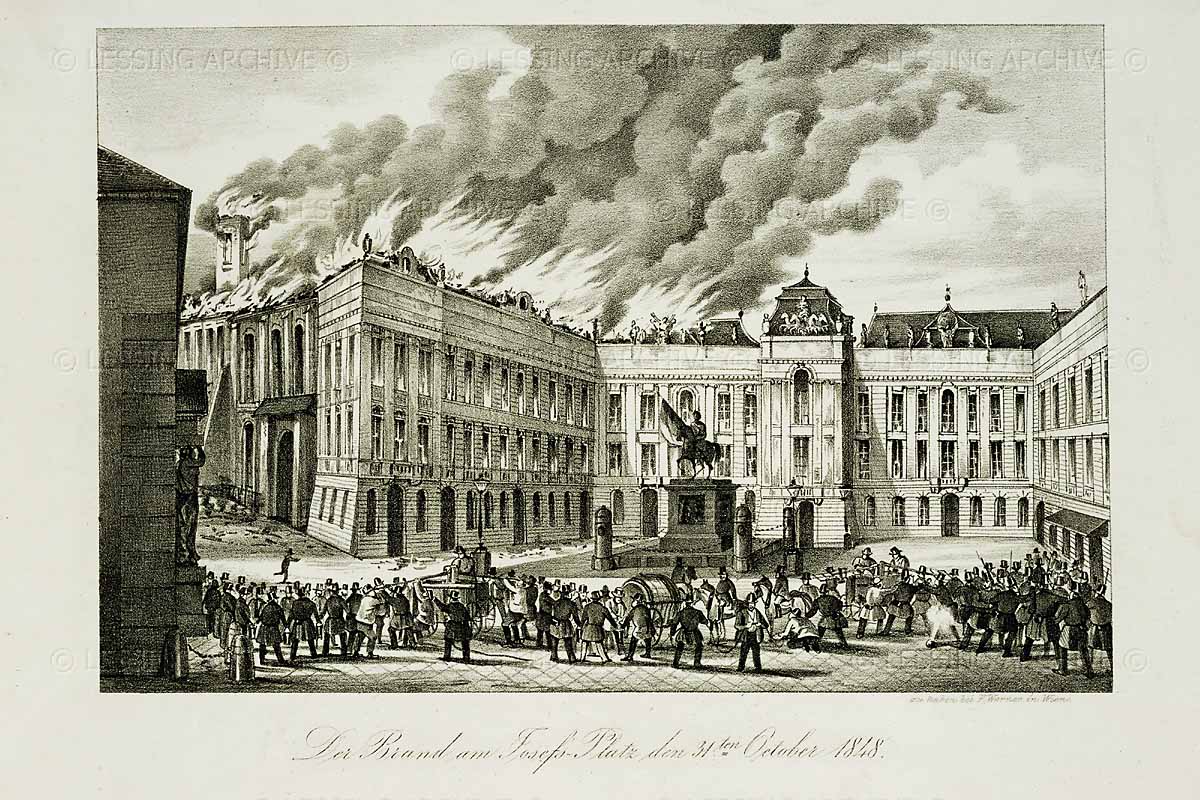
Anonymous (19th century)-'fire in Österreichische Nationalbibliothek, October 31, 1848'   Wien-Historisches Museum der Stadt Wien

11.1.12

Vienna


Vienna’s social life of the Habsburgs and of the Republic, as well as its monuments, is well documented in the work of many artists.

A vida social de Viena dos Habsburgos e da República, tal como os seus monumentos, encontra-se bem documentada nos trabalhos de inúmeros artistas.


Rudolf Franz Ullmann (1889-1973)-'restaurant Hirschengstaemm in Lainzer Tiergarten, Vienna'-oil on canvas-1944   Wien-Historisches Museum der Stadt Wien

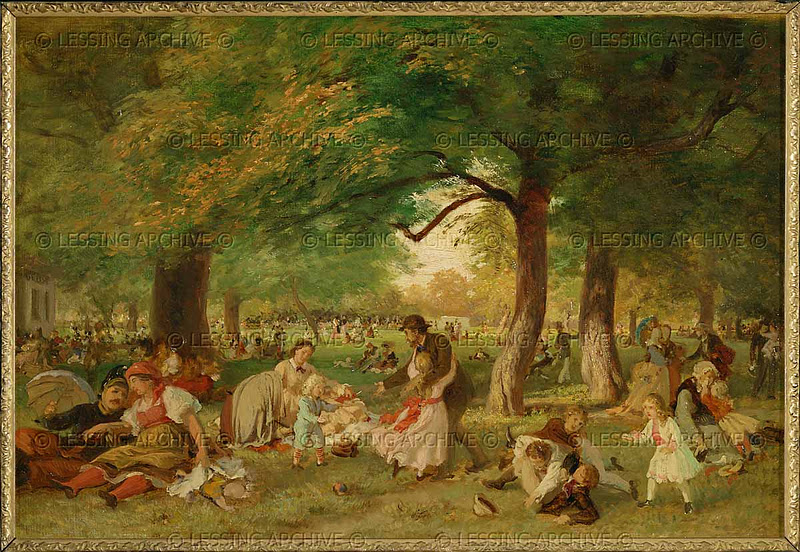
Ferdinand Julius Wilhelm Laufberger (1829-1881)-'an afternoon in the Prater'-oil on canvas-1881   Wien-Historisches Museum der Stadt Wien

Joseph Schaffer (1757-1825)-'the Viena General Hospital and narrenturm, the fools tower'-engraving-1787   Wien-Historisches Museum der Stadt Wien

Wilhelm Gause (1853-1916)-'the Graben central square in downtown Vienna; in the background the Plague Column'-1888    Wien-Historisches Museum der Stadt Wien

Unknown-'satire on the waltz-madness of the Viennese the Great Gallop'-coloured engraving-1939   Private collection

6.11.11

Vienna revolution 1848 (II)


The revolution had an apparent nationalistic feature because of the uprisings within the
Empire (Hungarians, Slovenes, Czechs, Slovaks, Croats, Serbs, Italians) but in reality it was organized by a socialist current.

A revolta tinha aparente carácter nacionalista por levantamentos pelo Império (Húngaros, Eslovenos, Checos, Eslovacos, Croatas, Sérvios, Italianos) mas na realidade foi organizada por corrente socialista.

Johann Nepomuk Höfel (1788-1964)-'the first uncensored newspaper are sold in street of Vienna after the revolution of 1848'-watercolour   Wien-Historisches Museum der Stadt Wien

Anton Ziegler-'big barricade on Michaeler square, May 26-27, 1848'-oil on canvas   Wien-Historisches Museum der Stadt Wien

Anonymous Austrian painter (19th century)-'officer Johann Pollet refuses orders to tram his cannons on the people of Vienna, 1848'-coloured lithograph   Wien-Historisches Museum der Stadt Wien

Anonymous (19th century)-'Archduke Johann inaugurating the Imperial Constitutional Assembly on June 22, 1848 (the meeting took place in the Hall of the Spanish Riding School)'-lithograph hand-coloured   Wien-Historisches Museum der Stadt Wien

Franz Schams-'guard room of the Academic League in the Hall of Vienna's Old University in City Center'-pen, and watercolour   Wien-Historisches Museum der Stadt Wien

Anonymous (19th century)-' a day-labourers' uprising is broken up by the National Guard in Vienna Prater on August 23, 1848´-lithograph hand-coloured       Wien-Historisches Museum der Stadt Wien

12.9.11

Vienna revolution


March 1848
The Revolution of 1848 centered in Vienna, seat of the Habsburg Empire, took place between March and October. The confrontations were sometimes violent. Over the last few days the minister of war was hung near the imperial palace and the National Library was burned. On 13th March, after 30 years in power, Prince Klemensvon Metternich was dismissed from his prime minister post by the Emperor Ferdinand I.

A revolução de 1848 centralizada em Viena, sede do Império dos Habsburgos, decorreu entre Março e Outubro. Os confrontos foram por vezes violentos. Nos últimos dias enforcaram o ministro da guerra perto do palácio imperial e incendiaram a Biblioteca Nacional. Depois de 30 anos no poder o Imperador Ferdinand I demitiu o Príncipe Klemens von Metternich do cargo de primeiro-ministro a 13 de Março.

J. Albrecht-'soldiers disperse demonstrating crowds in front of the Lower Austrian Diet in Vienna on March 13, 1848-coloured lithograph   Wien-Historisches Museum der Stadt Wien

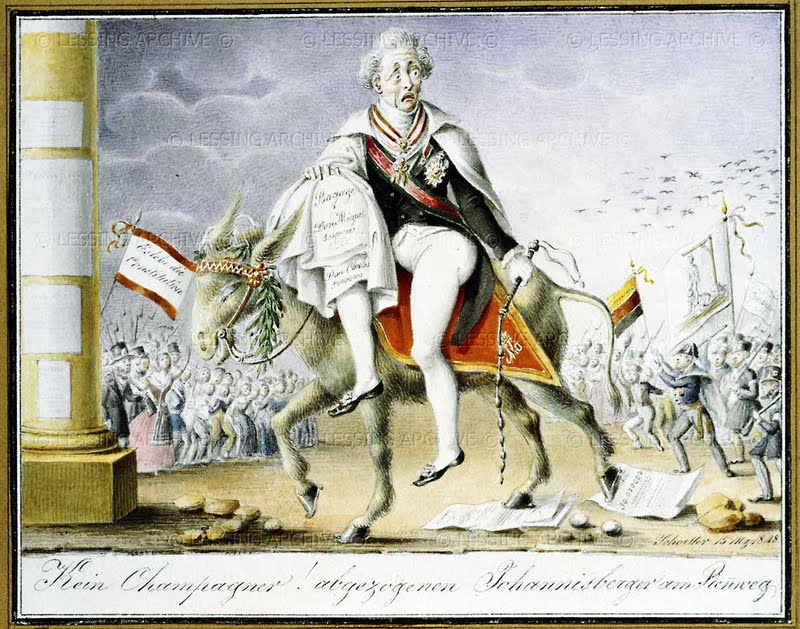
Johann Christian Schöller (1782-1851)-'caricature of the role of Chancellor Metternich during the revolution of 1848'    Wien-Furst Metternich Palast

Franz Kaliwoda ( -1859)-'storm on the factory at Granichstaetten in Vienna, March 14, 1848'-watercolour, pen and sepia   Wien-Historisches Museum der Stadt Wien

Anonymous-'evening on March 15, 1848 in Vienna'-lithograph-19th century   Wien-Historisches Museum der Stadt Wien

Anonymous-'the popular poet Friedrich Kaiser reading out the Constitution on March 15, 1848 in Vienna'-hand-coloured lithograph-19th century   Wien-Historisches Museum der Stadt Wien

Franz Gaul (1837-1907)-'a group of armed railways, led by a student of the Academic League, on their way to the center of Vienna, May 26, 1848'-watercolour   Wien-Historisches Museum der Stadt Wien

21.12.10

Ancient Vienna (Viena de outras eras)

There is pictorial documentation of the 19th Century city of Vienna and its inhabitants' lives. It can be seen in the work of Johann Adolf Opitz (1763-1825), Rudolf von Alt (1812-1905) and others. Some of these photos and many more are from the Austrian excellent professional Erich Lessing (1923 -).


Do séc. XIX existe documentação pictórica sobre a cidade e vida dos seus habitantes. São exemplos as obras de Johann Adolf Opitz (1763-1825), Rudolf von Alt (1812-1905) e outros. Algumas destas fotografias e muitas mais são do excelente profissional Austríaco Erich Lessing (1923- ).

William Wordworth (1770-1850)-'neue Markt (Mozart and Haydn lived nearby)'-coloured engraving

Johann Adolf Opitz (1763-1825)-'butchershop and butcherboy with dog and a lady buying silk ribbons from a Tyrolean hawker'-watercolour-ca 1810 Wien-Historisches Museum der Staadt

Rudolf von Alt (1812-1905)-'Michaelerplatz und Kohlmarkt (the Michaelerhaus where Pietro Metastasio lived and died and 16year-old Joseph Haydn had his lodging-currently with Roman ruins of Vindobona in the center of square)'-watercolor (Aquarell auf Papier) Private collection

Rudolf von Alt (1812-1905)-'church of Hofburg'-watercolor-1892 Private collection

Rudolf von Alt (1812-1905)-'die Jägerzeile' 'hunter line'-watercolor-1844 Private collection

14.3.10

Vienna "House of Austria"


The Turks of the Ottoman Empire, led by Kara Mustafa, were defeated in the 2nd Siege (1683) with the help of Jan Sobieski III, king of Poland. He meets Leopold I, King of the Holy Roman emperor, in Schwechat.
Oil on canvas of the Polish artist Artur Grottgera (1837-1867) exhibited in Lviv (Ukraine) - Art Gallery.


Os Turcos do Império Otomano, comandados por Kara Mustafa, foram vencidos no 2º cerco (1683) com auxílio de Jan Sobieski III, rei da Polónia. Este encontra-se em Schwechat com Leopoldo I, rei do Sacro Império Germano-Romano, óleo sobre tela do pintor Polaco Artur Grottger (1837-1867), exposto em Lviv (Ucrânia) - Galeria de Arte.


Prince Eugene of Savoy (1663-1736) pursued and defeated the Turks to Bulgaria. To prove that the enemy wouldn’t return he built the 1st palace outside the walls.
Equestrian statue in Heldenplatz, burial in the Cathedral.


O Príncipe Eugénio de Saboia (1663-1736) perseguiu e derrotou os Turcos até à Bulgária. Para provar que o inimigo não regressava construiu o 1º palácio fora das muralhas. Estátua equestre na Heldenplatz; sepultura na Catedral.


Bernardo Bellotto (1720-1780), known to the Austrian court as Canaletto (because he was the nephew of Giovanni Antonio Canale), executed a painting that enables people to enjoy views of Vienna seen from Prince Eugene’s palace, the present site of the Österreichscher Galerie Belvedere.

Bernardo Bellotto (1720-1780), conhecido na corte austríaca por Canaletto (por ser sobrinho de Giovanni Antonio Canale), executou uma pintura onde se aprecia Viena vista do palácio do Príncipe Eugénio, local da actual Österreischische Galerie Belvedere.


Panel (1779) showing Stock-im-Eisenplatz and Stephandom


General Gomes Freire (birth), 1st Marquis de Pombal (ambassador), D. Miguel I (1st exile 1823-1826)